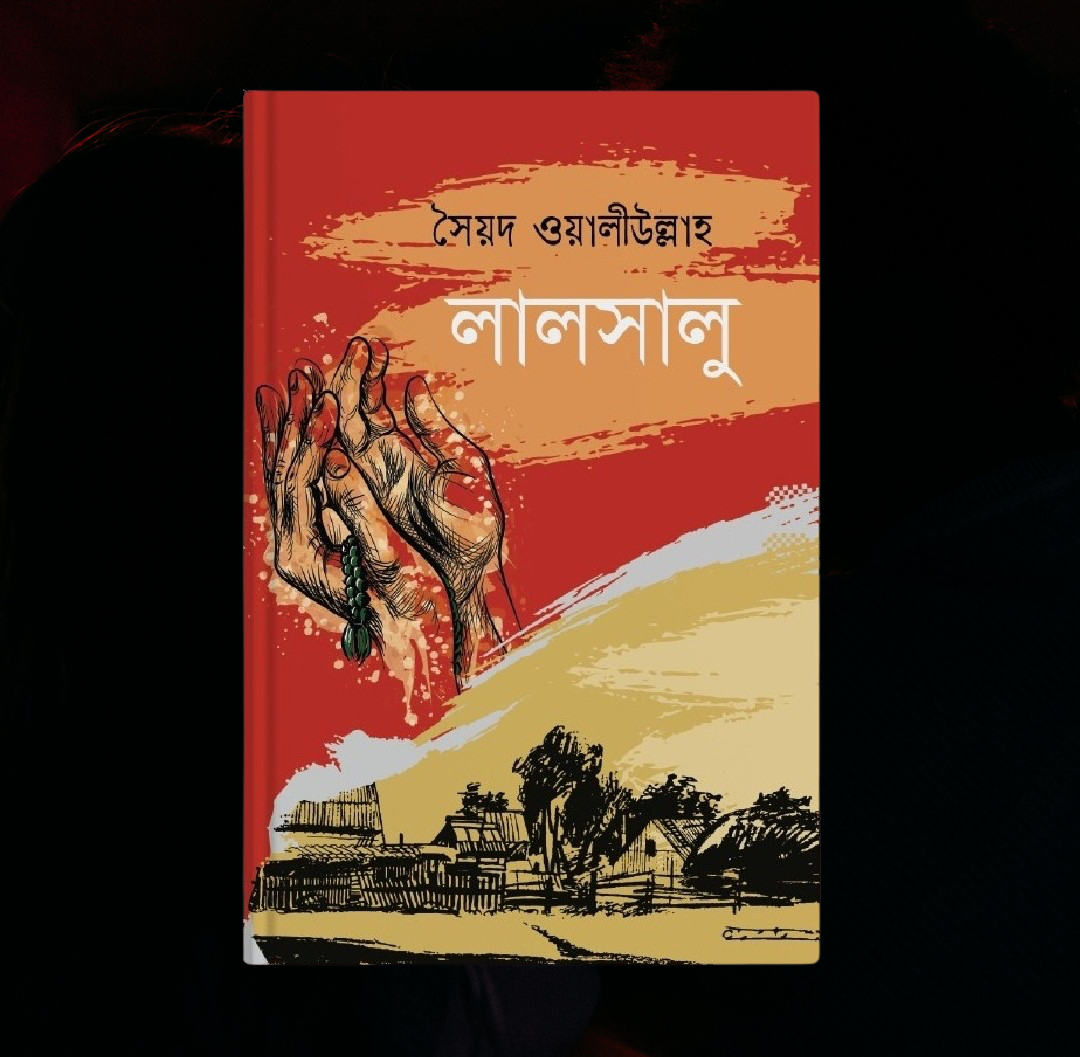
If you grew up in Bangladesh and studied in the national curriculum, chances are you’ve met Majid—the manipulative “saint” at the center of Syed Waliullah’s iconic novel, Lalsalu (Tree Without Roots). It’s that haunting story from our Class 11–12 Bangla textbook—the one that made us question superstitions, fake piety, and what it means to blindly follow someone dressed in religious robes.
But as I revisited it recently, something didn’t sit right. Yes, Lalsalu is bold. It’s sharp. It says the quiet parts out loud. Yet, while praising its strengths, we have to ask: does it sometimes swing too far? Does its satire of hypocrisy accidentally slip into mocking genuine faith?
Let’s break it down.
The Good Stuff: Calling Out the Cons
Lalsalu’s strongest suit? Its fearless takedown of blind superstition. Waliullah calls out absurd beliefs that still echo in parts of our society—like thinking thumping your feet makes the earth angry, or that a Pir can control the sun and moon (shoutout to the Pir of Awalpur who legit claims that). It exposes how some people believe praying at a saint’s grave will shortcut your prayers to God, or how circling while fasting might help you get pregnant. These aren’t religious teachings—they’re cultural distortions passed down like bad Wi‑Fi.
Some might argue: “Waliullah is clearly lampooning hypocrites like Majid, not sincere believers.” True, the novel targets a fraudster. But if your only reference for “doing religious stuff” in literature is a character like Majid—who uses beards and mosques as power tools—then a quick read can end up equating “beard = oppressive ritual” or “mosque = means to control.” That’s the slipperiness I worry about. Even if the intention is to satirize fake piety, depicting every act of devotion through Majid’s twisted lens can skew perception: readers might see “a person who prays” and immediately think, “Ah, another charlatan in the making.”
Still, give credit where it’s due. Lalsalu makes us think twice about who we trust. It forces us to question the difference between true faith and performative religion. If it stopped there—exposing charlatans while leaving authentic devotion intact—I’d call it a modern classic.
But Let’s Talk About the Problem Areas
Here’s where things get murky. Lalsalu doesn’t just criticize the misuse of religion—it sometimes feels like it ridicules religion itself, and that’s where I hit pause.
1. Mocking Poor Kids in
Maktab
The novel opens with poor children attending a maktab (a pre-primary religious school). Rather than evoking empathy for kids trying to learn, it portrays them as objects of mockery:
“এ যেন খোদা তালার বিশেষ দেশ”—“As if this land belongs specially to God.”
“শস্যের চেয়ে টুপি বেশি, ধর্মের আগাছা বেশি”—“More caps than crops, more weeds than religion.”
You might think, “Waliullah is critiquing how poverty can force people into superstition.” But the effect is different: the lines read as “Haha, look at these poor kids wrapped in straw mats, praying while they have nothing.” That’s not “punching up” at systemic neglect—it’s “punching down” at people whose only refuge is faith. Genuine religion becomes the punchline, rather than the social forces that pushed them there.
Sure, some readers claim: “It’s social commentary, not an attack on faith. Poverty + piety = tragedy, not farce.” But if a student skims those lines—maybe under exam pressure—they’ll likely hear “poor kids who believe in God are pathetic.” Instead of sympathy, there’s snickering. And that’s exactly why I say: when the text laughs at someone’s devotion—however distorted—readers risk conflating faith with foolishness.
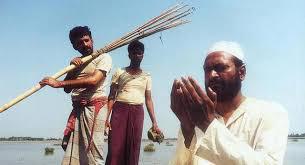
2. Undermining Trust in God After Disaster
In the climax, a heavy rain destroys the villagers’ crops. Majid—ever the opportunist—tells them to keep faith in God: “Trust Allah to rebuild your lives.” In context, it’s meant to show how he cynically reasserts control when his power foundation (fear) is shaken. But read quickly, it comes across as “Lalsalu
says, ‘Don’t trust God; it won’t help.’”
You could argue: “No, Majid’s plea for faith is a narrative device showing his manipulation, not a denigration of faith itself.” Fair point. In a detailed literary class, a teacher might highlight: “See how Majid uses faith like a tool.” But what about the students who just flip pages right before exams? Without that teacher note, they’ll take it at face value: “Trusting God after real loss? Silly. Lalsalu says that’s gullible.” That contradicts most religious teachings that encourage resilience and hope after hardship. If they come away thinking, “Having faith in God when everything falls apart is foolish,” then Lalsalu has unintentionally denigrated genuine belief.
When Simple Practices Become Tools
Another major concern: Majid takes standard religious practices—normally seen as sincere acts—and twists them into weapons, making every ritual look oppressive.
- Beard vs. School: Majid confronts Akkas about his beard not because piety itself is an issue, but because Akkas was attempting to build a school that would introduce modern education to the village. By questioning his faith and deflecting the conversation to building a mosque instead, Majid kills the idea of the school. It’s brilliant manipulation: instead of debating education, the villagers get roped into a mosque project that boosts Majid’s image. But read flatly, you might think, “Why does the novel show a beard as a political weapon?” And you can miss that Majid’s true target was Akkas’s school, not genuine devotion.
- Kalima and Dudu Miya: Then there’s Dudu Miya—a poor, elderly man—being grilled on whether he knows the Kalima. The subtext seems to be: “Dudu Miya is already so poor, what’s the point of him knowing this simple creed?” In other words, the text uses his poverty to make his faith look comical. But any honest Muslim knows: reciting the Kalima is the foundation of belief, not a luxury for the wealthy. By depicting a destitute old man’s faith as laughable, the novel risks sending a message that “If you’re poor, your belief is irrelevant or silly.”
- Amena Bibi’s Friday Fast: Finally, there’s Amena Bibi—Khalek Bepari’s first wife—forced to fast on Fridays and walk in circles around the yard to prove she can be pregnant. In reality, no mainstream teaching in Islam says fasting and walking in circles guarantees fertility. It’s a superstitious, extra-Islamic practice Majid uses to control her. But if you haven’t grown up distinguishing cultural distortions from core teachings, you might assume Lalsalu is showing what “Muslims really do,” rather than what Majid is making them do. The risk? Readers blur the line between “Majid’s dodgy rites” and “real religious guidance.”
Some might argue that Lalsalu isn’t mocking these practices per se—just showing how Majid exploits them. True, the intention is to highlight his con. But when every standard ritual is portrayed only through his exploitation, it blurs the line between condemnation of manipulation and an attack on faith itself. A reader could easily conclude: “Those religious acts Majid uses—beards, Kalima, Friday fasts—they’re all red flags for oppression.”
The Agenda Question: What Was Waliullah Really Saying?
By now, you’ve probably heard: “Syed Waliullah’s agenda wasn’t to undermine religion; he wrote Lalsalu to probe fanaticism.” That’s valid—his intention was to expose how faith can be twisted into tyranny. But intention and reception can diverge wildly.
- Intended Target: Majid’s corruption and the villagers’ blind compliance.
- Possible Result: Readers equate all religious devotion with “blind compliance.”
A book that claims to battle superstition shouldn’t inadvertently make readers cynical about any religious practice. And that’s the uneasy tension in Lalsalu—it bravely exposes exploitation but sometimes muddles the message so that genuine faith feels under attack.
Final Thoughts
Lalsalu is powerful. It stirs, provokes, and challenges the reader. But it’s also imperfect. While it rightly exposes how faith can be manipulated, it sometimes skates too close to mocking faith itself. It’s one thing to lampoon charlatans; it’s another to leave young readers thinking, “Religion itself is the joke.”
Gen Z, we’re wired to question everything—and that includes the narratives handed to us in textbooks. Lalsalu is worth reading. But read it with your eyes open and your critical thinking turned all the way up. Know the difference between true devotion and a money-hungry impostor. Remember that a beard, reciting the Kalima, or a Friday fast doesn’t automatically mean someone’s being used. And don’t let the novel’s one-dimensional caricatures overshadow the authentic practices millions hold dear.
In short: Lalsalu can teach us to spot frauds, but it can’t be our only teacher about faith. Because blind belief is dangerous—but blind doubt can be just as harmful.